The Range Ball Reality Check: Which Practice Numbers Survive a British Winter?

Photo: driving range launch monitor screen and golf balls in cold weather UK, via www.endurancewarranty.com
Range bay screens have become the reassuring voice of winter practice. You hit a shot, the screen gives you a carry number, and for a second everything feels scientific. Then you get to the course, hit what feels like the same 7-iron, and watch the ball land 15 yards short of your summer spot. The screen wasn't necessarily broken. It was just answering a different question.
Range balls are not your ball
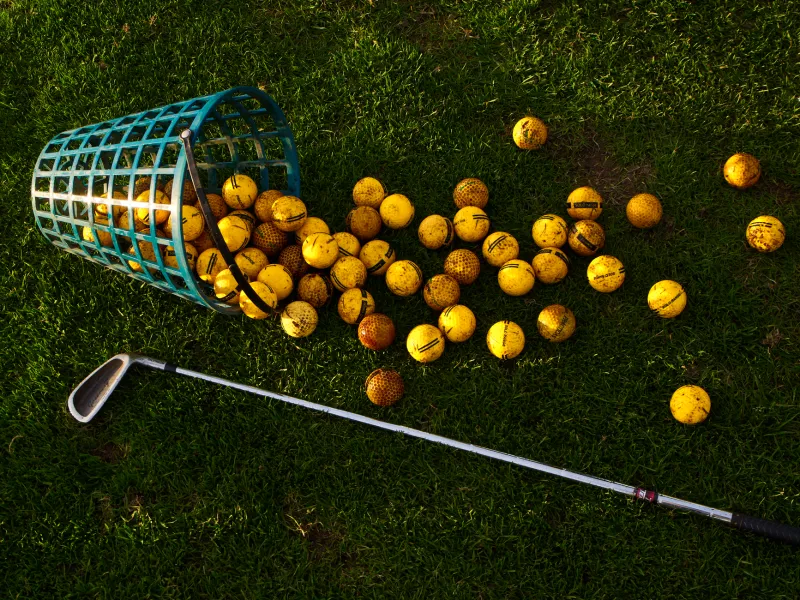
A driving range ball is built for survival, not for your game. It has probably been hit more times than a clubhouse door, may be scuffed, and is often a limited-flight or distance-controlled model. Add cold air, a hard mat and a crosswind that swirls around the bay, and you have a perfect storm for numbers that don't match your Saturday fourball.
That doesn't mean every figure on the screen is useless. It means you need to separate process numbers from outcome numbers. Process numbers describe your swing: strike location, start line, low point, clubhead speed, curve. Outcome numbers describe the ball's journey: carry, total, spin, apex. In winter, the outcome numbers are the ones most easily influenced by the ball and the weather.
The numbers I'd ignore
Total distance is the biggest liar on a UK range. Roll on a range surface is not fairway roll, and a tired ball will not behave like the premium ball in your bag. Treat total as a relative signal — did this shot go further left or right than the last? — not as a club-selection number.
Spin is also suspect. Range balls are not designed to match your gamer's cover, construction or spin profile, and many bay screens estimate spin rather than measure it. Cold air and wind can make the model look confident while being a few hundred rpm out. If you're working on wedge spin or driver launch, the range is the wrong laboratory unless you're using your own ball.
Smash factor is another number to handle with care. It's useful for comparing your own strikes on the day, but the ball's lower ball speed can drag the figure down. Don't compare your range smash factor to a tour pro's number and decide your driver is broken.
The numbers worth trusting
Clubhead speed is usually worth a look if the bay has a radar or camera that measures it directly. It tells you whether your speed is holding up in the cold, and it's less dependent on the ball than carry or spin. Use it to spot fatigue or a loss of speed, not to chase a personal best in a heated bay.
Start line and curve are much more reliable. A range ball may not travel the same distance, but it still tells you where the clubface was pointing and how the ball curved. If your stock shot is a gentle draw and the range ball is starting right and cutting, that's real feedback. Work on a window between two alignment sticks and ignore the carry number.
Strike location is the most honest number in the bay. Put powder or impact tape on the face and look at the cluster. Heel and toe strikes don't care what ball you're using. Neither does low point. A mat can mask a fat shot, but a towel behind the ball or a tee ahead of it will tell you whether you're bottoming out in the right place.
Dispersion is also worth tracking. Not the absolute distance, but the shape of your misses. If 10 balls with an 8-iron finish in a neat ellipse, that pattern will travel to the course even if the yardage doesn't.
How to benchmark your range
First, find out what your range actually does to the ball. If the facility allows it, hit 10 range balls and 10 of your gamer balls with the same club from the same bay. Record carry and ball speed and note the difference. Some UK ranges are strict about own balls, so ask first; if they say no, use a short-game area or a net session where you can bring your own ball.
Second, build a winter club map. Take your summer carry numbers and subtract a sensible cold-weather allowance. You don't need a spreadsheet, just a note on your phone: 7-iron summer 150, winter 142; 5-iron summer 175, winter 165. Then use the range to check strike and start line, not to re-write the map every week.
Third, pick one control club. For most players, that's a 7-iron or 8-iron. Hit 10 balls, write down the carry and the strike pattern, and repeat next session. The trend matters more than the exact number.
Make winter practice travel
Use the range for what it's good at: repetition, feedback and a warm bay when the light has gone. Set process goals — eight out of 10 centred strikes, seven out of 10 start lines through the gate, no towel hits — and let the distance look after itself. When you get to the course, trust your winter club map and your dispersion pattern, not the range screen's total.
The range ball isn't lying on purpose. It's just not your ball, and a UK winter is not a laboratory. Use the numbers that describe your swing, ignore the ones that describe the ball's bad day, and your winter practice will actually show up when it matters.